Anatomy of a Surge Arrester: Understanding the Components That Protect Electrical Power Systems

0
Anatomy of a Surge Arrester: Understanding the Components That Protect Electrical Power Systems
Lightning strikes and switching operations are an unavoidable part of modern electrical power systems. While these events last only a fraction of a second, they can generate extremely high voltage surges capable of damaging transformers, switchgear, cables, motors, and other critical equipment.

Without proper protection, these transient overvoltages can lead to costly repairs, unexpected downtime, and reduced system reliability. This is where a surge arrester plays a crucial role.

A surge arrester is one of the most important protective devices used in transmission and distribution networks. Its primary function is to safely divert excessive surge energy to the ground before it reaches sensitive equipment. Although it may appear simple from the outside, a modern polymer surge arrester consists of several carefully engineered components that work together to deliver reliable protection.

In this blog, we'll explore the anatomy of a surge arrester, understand the function of each component, and learn why every part contributes to protecting electrical power systems.


What Is a Surge Arrester?

A surge arrester is a protective device installed between the power line and earth. Under normal operating conditions, it behaves like an insulator, allowing almost no current to flow. However, when a high-voltage surge caused by lightning or switching operations occurs, the arrester instantly changes its electrical characteristics and provides a low-resistance path for the surge current to flow safely into the ground.

Once the surge has passed, the arrester automatically returns to its normal insulating state, allowing the power system to continue operating without interruption.

Because of this fast response, surge arresters are widely installed on:

⚡ Transmission & Distribution Lines

⚡ Power Substation Transformers

⚡ Switchgear & Ring Main Units (RMUs)

⚡ Renewable Energy Grid Frameworks


Anatomy of a Polymer Surge Arrester

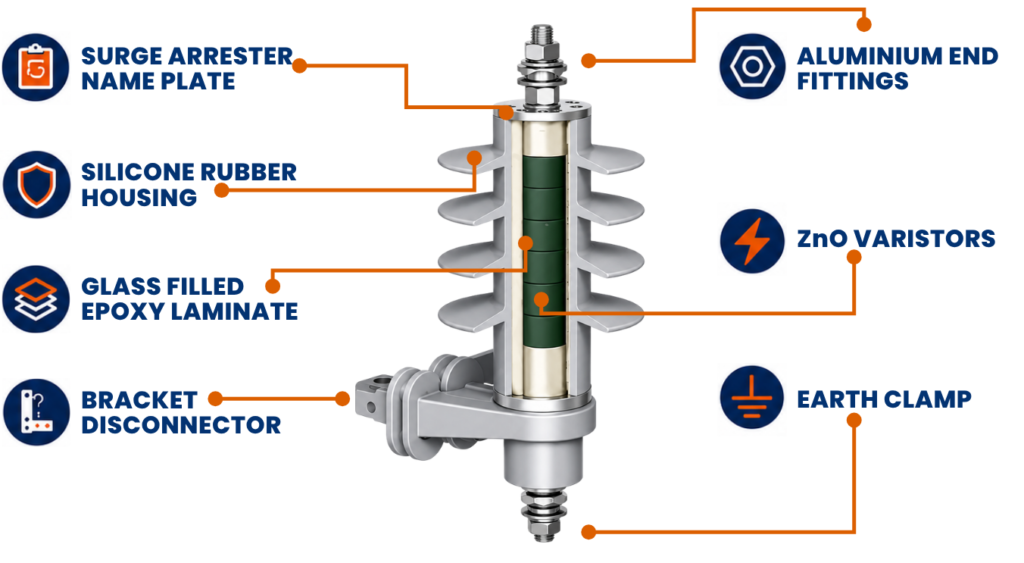
A modern polymer surge arrester is made up of several components, each designed to perform a specific function. Let's look closely at the mechanical and material engineering running inside the chassis below.

ANATOMY OF A SURGE ARRESTER

COMPONENTS OF A SURGE ARRESTER

1. Aluminium End Fittings

The aluminium end fittings are located at both ends of the surge arrester. They provide the critical electrical connection interfaces between the arrester assembly, the incoming power lines, and the low-resistance grounding networks.

Apart from carrying electrical current during surge events, these fittings provide essential structural cantilever strength. This enables the entire device to easily withstand intense environmental factors like high-velocity wind loads, lines tensions, and vibrations.

🔸 Electrical Connection: Lowers interface contact degradation risks over time.
🔸 Mechanical Support: Absorbs mechanical stress and physical load variations safely.
🔸 Corrosion Resistance: High-grade alloy construction guarantees long field operational limits.

2. Silicone Rubber Housing

The outer silicone rubber housing acts as the primary external shield against hostile weather elements. Compared to outdated legacy porcelain variants, high-performance polymer silicone offers highly effective structural insulation while being extremely lightweight and shatterproof.

The core advantage lies in its hydrophobic surface properties. Because it repels standing moisture naturally, it prevents continuous water trails from forming, substantially lowering leakage currents and eliminating tracking damage in heavy industrial, saline, or high-pollution zones.

3. Glass-Filled Epoxy Laminate

Deep inside the housing rests a glass-filled epoxy laminate cylinder or internal rigid framing that acts as the physical structural core. Though invisible from the exterior, it provides massive mechanical rigidity, locking the internal varistor stacking blocks under a specific compression load to maintain continuous electrical contacts through decades of weathering.

4. Zinc Oxide (ZnO) Varistors

The gapless Zinc Oxide (ZnO) varistor blocks are the true performance engine of the surge arrester. They are engineered from sintered metal-oxide ceramics that display a highly non-linear voltage-to-current profile governed by mathematical coordination principles.

I = k · Vα (where degree of non-linearity α = 30 to 50)
🔸 Steady State Monitoring: The internal ceramic block junctions present giga-ohms of resistance, safely isolating the power loop under maximum continuous operating voltage (MCOV).
🔸 Transient Breakthrough: The moment a high-voltage surge crosses safe parameters, the internal grain boundaries drop their resistance instantly. This channels the dangerous current wave directly to the ground loop.

5. Surge Arrester Name Plate

Every industrial-grade surge arrester features an integrated technical nameplate that catalogs vital insulation coordination specifications. Understanding these parameters ensures safe operational matching, detailing the core Rated Voltage parameters alongside the critical Maximum Continuous Operating Voltage (MCOV) threshold constraints and global regulatory testing verification stamps (IEC 60099-4).

6. Bracket Disconnector

The base mounting bracket is paired with an automatic pyrotechnic ground lead disconnector. If a massive lightning bolt overrides the thermal energy handling capabilities of the ZnO blocks, a continuous short-circuit fault path could threaten the line grid.

The disconnector senses this sustained power frequency current fault and activates a small isolating charge. This instantly blows the ground cable free from the base, isolating the faulty unit to protect the network from locked ground faults while providing ground teams with a clear visual maintenance cue.

7. Earth Clamp

A protective device is only as effective as the ground configuration it connects to. The earth clamp locks the low-impedance grounding copper conductors securely to the base terminal. This ensures that transient energy dumps quickly into the earth pool before inductive voltage surges can loop back to damage adjacent transformers.

1. Aluminium End Fittings

The aluminium end fittings are located at both ends of the surge arrester. They provide the critical electrical connection interfaces between the arrester assembly, the incoming power lines, and the low-resistance grounding networks.

Apart from carrying electrical current during surge events, these fittings provide essential structural cantilever strength. This enables the entire device to easily withstand intense environmental factors like high-velocity wind loads, lines tensions, and vibrations.

🔸 Electrical Connection: Lowers interface contact degradation risks over time.
🔸 Mechanical Support: Absorbs mechanical stress and physical load variations safely.
🔸 Corrosion Resistance: High-grade alloy construction guarantees long field operational limits.

2. Silicone Rubber Housing

The outer silicone rubber housing acts as the primary external shield against hostile weather elements. Compared to outdated legacy porcelain variants, high-performance polymer silicone offers highly effective structural insulation while being extremely lightweight and shatterproof.

The core advantage lies in its hydrophobic surface properties. Because it repels standing moisture naturally, it prevents continuous water trails from forming, substantially lowering leakage currents and eliminating tracking damage in heavy industrial, saline, or high-pollution zones.

3. Glass-Filled Epoxy Laminate

Deep inside the housing rests a glass-filled epoxy laminate cylinder or internal rigid framing that acts as the physical structural core. Though invisible from the exterior, it provides massive mechanical rigidity, locking the internal varistor stacking blocks under a specific compression load to maintain continuous electrical contacts through decades of weathering.

4. Zinc Oxide (ZnO) Varistors

The gapless Zinc Oxide (ZnO) varistor blocks are the true performance engine of the surge arrester. They are engineered from sintered metal-oxide ceramics that display a highly non-linear voltage-to-current profile governed by mathematical coordination principles.

I = k · Vα (where degree of non-linearity α = 30 to 50)
🔸 Steady State Monitoring: The internal ceramic block junctions present giga-ohms of resistance, safely isolating the power loop under maximum continuous operating voltage (MCOV).
🔸 Transient Breakthrough: The moment a high-voltage surge crosses safe parameters, the internal grain boundaries drop their resistance instantly. This channels the dangerous current wave directly to the ground loop.

5. Surge Arrester Name Plate

Every industrial-grade surge arrester features an integrated technical nameplate that catalogs vital insulation coordination specifications. Understanding these parameters ensures safe operational matching, detailing the core Rated Voltage parameters alongside the critical Maximum Continuous Operating Voltage (MCOV) threshold constraints and global regulatory testing verification stamps (IEC 60099-4).

6. Bracket Disconnector

The base mounting bracket is paired with an automatic pyrotechnic ground lead disconnector. If a massive lightning bolt overrides the thermal energy handling capabilities of the ZnO blocks, a continuous short-circuit fault path could threaten the line grid.

The disconnector senses this sustained power frequency current fault and activates a small isolating charge. This instantly blows the ground cable free from the base, isolating the faulty unit to protect the network from locked ground faults while providing ground teams with a clear visual maintenance cue.

7. Earth Clamp

A protective device is only as effective as the ground configuration it connects to. The earth clamp locks the low-impedance grounding copper conductors securely to the base terminal. This ensures that transient energy dumps quickly into the earth pool before inductive voltage surges can loop back to damage adjacent transformers.

VOLTAGE (V) —> CURRENT (I) —> 0 Micro-Amps (μA) Amperes (A) Kilo-Amps (kA) MCOV Limit KNEE POINT (Switching Zone) PROMINENT CLAMPING VOLTAGE BOUNDARY LEAKAGE ZONE SURGE CLAMPING ZONE
Non-linear Voltage vs Current ($V-I$) operational metrics mapping precision curve.

How Does a Surge Arrester Work?

The working mechanism of a modern surge arrester relies entirely on the rapid material transitions within its internal zinc oxide (ZnO) varistor blocks. Under standard operating conditions, the device monitors the grid passively, acting as an open circuit block. However, the moment a high-voltage transient hit occurs, the entire physical chemistry changes in microseconds.

When lightning strikes an overhead line or a heavy switching sequence induces overvoltages, the incoming wavefront hits the arrester and triggers a systematic chain reaction:

1. Microsecond Activation: The severe overvoltage wave triggers the internal zinc oxide ceramic matrices. The voltage across the arrester surpasses its defined threshold limit.
2. Resistance Collapse: The micro-junctions between the ZnO grains drop their electrical resistance instantly, falling down to absolute fractions of an ohm. This effectively changes the arrester from a strict insulator into a highly conductive path.
3. Safe Surge Discharge: The massive incoming impulse current wave bypasses the protected equipment entirely, channeling safely through the low-resistance core straight into the earth loop grid.
4. Clamping & Self-Recovery: The line voltage remains strictly clamped well below the insulation breakdown thresholds of downstream power transformers and switchgear. Once the surge energy dissipates completely, the ZnO blocks instantly reset back to their high-resistance insulating state, preventing any grid interruption.

Key Performance Features of Polymer Designs

Transitioning from traditional porcelain housings to polymer materials has significantly enhanced grid reliability. Modern polymer designs deliver distinct operational advantages for heavy-duty power engineering applications:

✔ Full Compliance with Standards: Engineered to satisfy universal regulatory testing requirements under standard industrial frameworks (such as IEC 60099-4).

✔ Direct-Moulded Moisture Protection: The silicone housing is direct-moulded over the core assembly to completely eliminate internal void hazards and structural air pockets, preventing moisture ingress.

✔ Superior TOV Capabilities: Exhibits exceptional Temporary Overvoltage (TOV) handling capacity, maintaining strict thermal stability under repetitive system imbalances.

✔ Maintenance-Free Lifespan: Offers an entirely maintenance-free operational lifespan extending easily past 25+ years in aggressive environmental zones.


Conclusion

A surge arrester is a highly sophisticated grid protection component despite its simple exterior appearance. Every individual sub-assembly—from the heavy-duty cast aluminium fittings and hydrophobic silicone rubber housing to the non-linear zinc oxide varistors—works in perfect coordination to shield electrical infrastructure from transient overvoltages. Mapping out this anatomy ensures optimal engineering design selection, keeping power grids worldwide operational, efficient, and safe from severe environmental and system stresses.

About the Author:

Meghna Baid

Meghna Baid is a marketing professional with 7 years of experience, specializing in the electrical industry. She excels in brand building, strategic messaging, and high-impact campaigns, blending creativity with data-driven precision. With a sharp understanding of B2B and technical markets, she crafts compelling narratives that drive results and build strong industry connections.

Reach out to her at marketing@relcoelectrical.com


Leave a Reply

Your email address will not be published. Required fields are marked *