
Why 11kV? The Hidden Engineering Behind Voltage Standards
Wherever electricity flows — from a rooftop solar array to a city of millions — voltage levels like 11kV, 33kV, 66kV, and 132kV appear with uncanny regularity. Why not 10kV? Why not 25kV? These numbers are not coincidence. They are the fingerprint of over a century of engineering optimisation.
The question seems simple enough on the surface. But to truly answer it requires understanding the fundamental physics of power transmission, the economics of infrastructure, and the powerful momentum of industrial standardisation. Let's unpack all three.
The Foundation: Power, Voltage, and Current
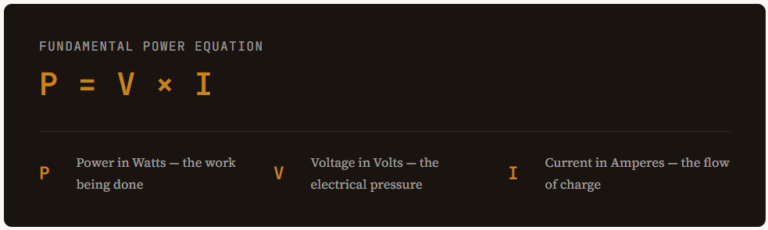
Every electrical system is governed by a deceptively simple equation
This equation tells us that any given amount of power can be delivered in different ways: high voltage with low current, or low voltage with high current. At first glance, these seem equivalent. They are emphatically not.
The Real Enemy: I²R Losses
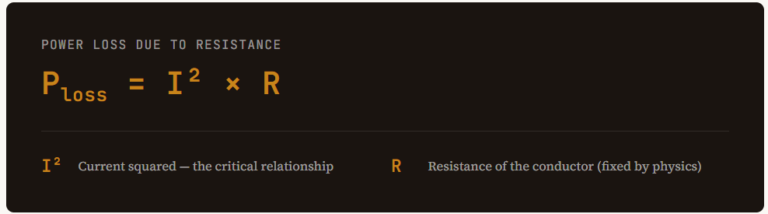
When current flows through any conductor — a copper wire, a transmission cable, a busbar — it encounters resistance. That resistance converts electrical energy into heat, which radiates away unused. This is the principle behind every electric heater and toaster, and it's the chief villain in long-distance power delivery.
The loss is described by one of the most important equations in electrical engineering:
Because losses scale with I², not I, a doubling of current produces four times the heat loss. Triple the current, and losses increase nine-fold. This non-linear relationship is what makes current management so critical in power systems.
The conductor's resistance is largely fixed by its material and cross-section — you can use thicker cable to reduce R, but only at great cost. The far more powerful lever is to reduce the current itself. And current, for a fixed power delivery, can only be reduced one way: by increasing voltage.
The Mathematics of Efficiency
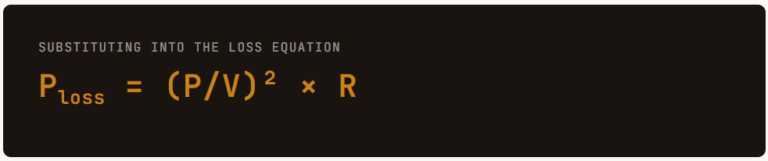
Combining both equations reveals the core engineering insight that shaped modern power infrastructure. If we rearrange P = VI for current:
Key Engineering Insight
Losses are inversely proportional to the square of voltage. Double the voltage, and losses fall to one quarter. Increase voltage ten-fold, and losses plummet to one hundredth. This is the mathematical foundation of every modern power grid.
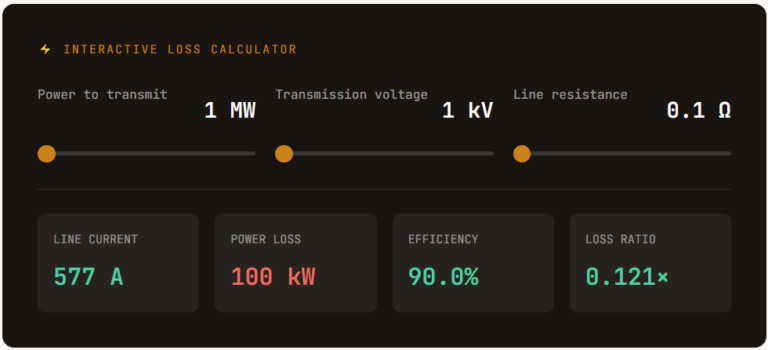
The practical consequences are dramatic. Consider transmitting 10 MW of power across a city:
By increasing voltage just 10× — from 1 kV to 10 kV — losses fall by a factor of 100. This is not a marginal improvement; it is the difference between a practical and an impractical grid.
So Why 11kV — Not 10kV or 12kV?
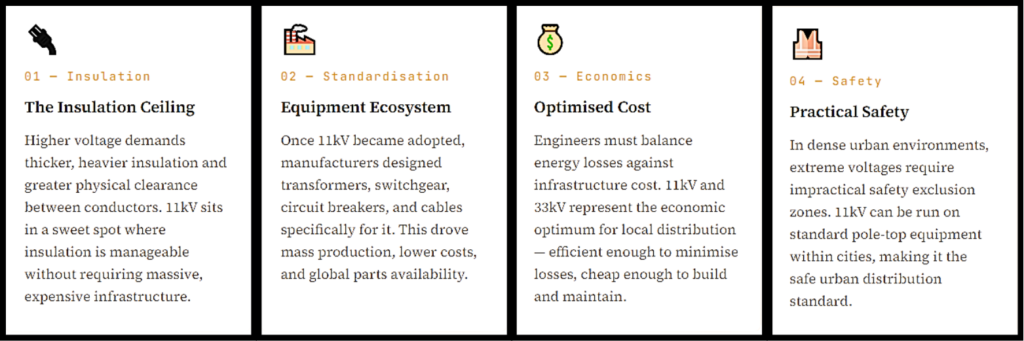
We've established why higher voltage is better. But that explains why we use high voltage generally — not why we use these specific values. The answer requires understanding the four engineering realities that shaped the standards.
The "Multiples of 11" Pattern — Real or Coincidence?
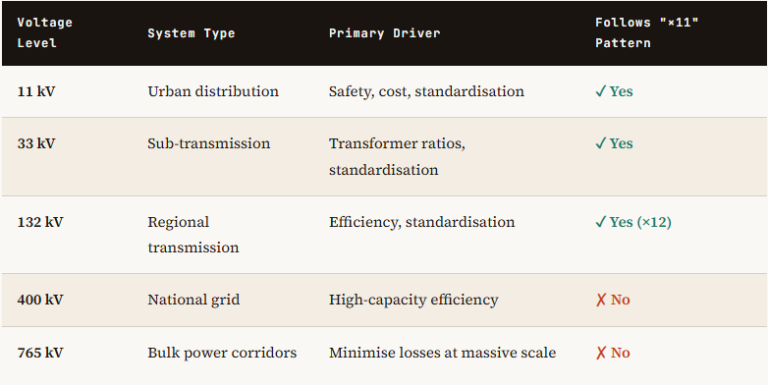
Yes, the pattern is real: 11kV, 22kV, 33kV, 66kV, 132kV — each a multiple of 11. But it's crucial to understand what this means. These values were not chosen because of some numerological preference for 11. They emerged because the first widely adopted standard worked well, and subsequent standards were chosen to maintain convenient transformer ratios.
If the step-up ratio between distribution levels is 3 (a common transformer ratio), then 11 → 33 → 132kV falls naturally out of the mathematics. The pattern is the result of engineering evolution, not its cause.
"In electrical engineering, nothing is random — everything is designed with purpose."
The Full Voltage Hierarchy
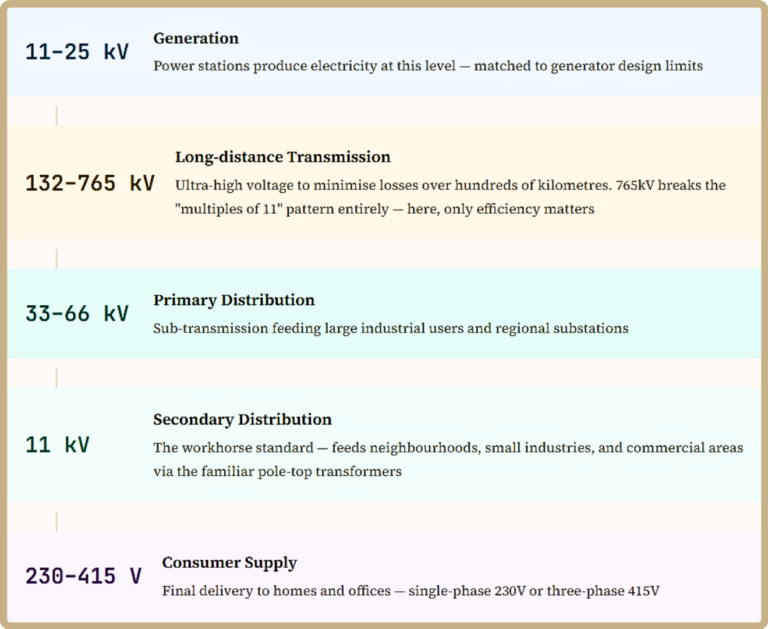
Modern grids don't use a single voltage — they use a carefully designed cascade, stepping power up for long-distance transmission and back down for local delivery:
Why 765kV Breaks the Pattern?
This is the question that trips up many students of electrical engineering. If the pattern is 11kV, 33kV, 66kV, 132kV — why does India's and America's backbone grid run at 765kV rather than 726kV (the nearest multiple of 11)?
Because at transmission scale, the "multiples of 11" convention is irrelevant. 765kV was selected through detailed engineering analysis of what voltage level optimally balances losses, conductor costs, insulator design, and right-of-way for bulk power corridors carrying thousands of megawatts over 500+ kilometre distances. No historical convention was going to override that calculation.
A Closing Note on Engineering Elegance
The story of voltage standardisation is really a story about how engineering solutions propagate through time. An early generation of electrical engineers — working in the 1890s and early 1900s — made pragmatic choices about voltage levels based on the technology available to them. Those choices worked well enough to become entrenched. Manufacturers built around them. Utilities adopted them. Training programmes taught them. Decades of infrastructure investment locked them in.
Today, when an engineer in Mumbai and an engineer in Manchester both specify an "11kV feeder," they are drawing on the same century-old decision. That continuity is not inertia — it is the compound interest of a good engineering choice.
The Takeaway
Standard voltage levels are not arbitrary numbers. They represent the intersection of physics (I²R losses), economics (infrastructure cost optimisation), safety (practical insulation limits), and history (the self-reinforcing momentum of standardisation). When you see 11kV on a nameplate, you're reading a century of engineering wisdom compressed into two digits.
About the Author:
Meghna Baid is a marketing professional with 7 years of experience, specializing in the electrical industry. She excels in brand building, strategic messaging, and high-impact campaigns, blending creativity with data-driven precision. With a sharp understanding of B2B and technical markets, she crafts compelling narratives that drive results and build strong industry connections.
Reach out to her at marketing@relcoelectrical.com
Related Post:https://www.linkedin.com/feed/update/urn:li:activity:7444370743544692736