Why Do We Need 400 kV, 220 kV, and 132 kV?
Decoding the Power Grid: Why Do We Need 400 kV, 220 kV, and 132 kV Transmission Levels?
Modern civilization runs entirely on electrical energy, yet the journey of electricity from its point of generation to the end consumer is an intricate engineering marvel. Power generation typically takes place on a massive scale at remote geographical locations—such as massive hydroelectric dams nestled in mountain ranges, giant thermal power stations situated near coalfields, or nuclear installations placed far away from urban populations. Transporting this generated power safely, reliably, and with optimal economic efficiency across hundreds or even thousands of kilometers requires a highly structured, hierarchical electrical grid system.
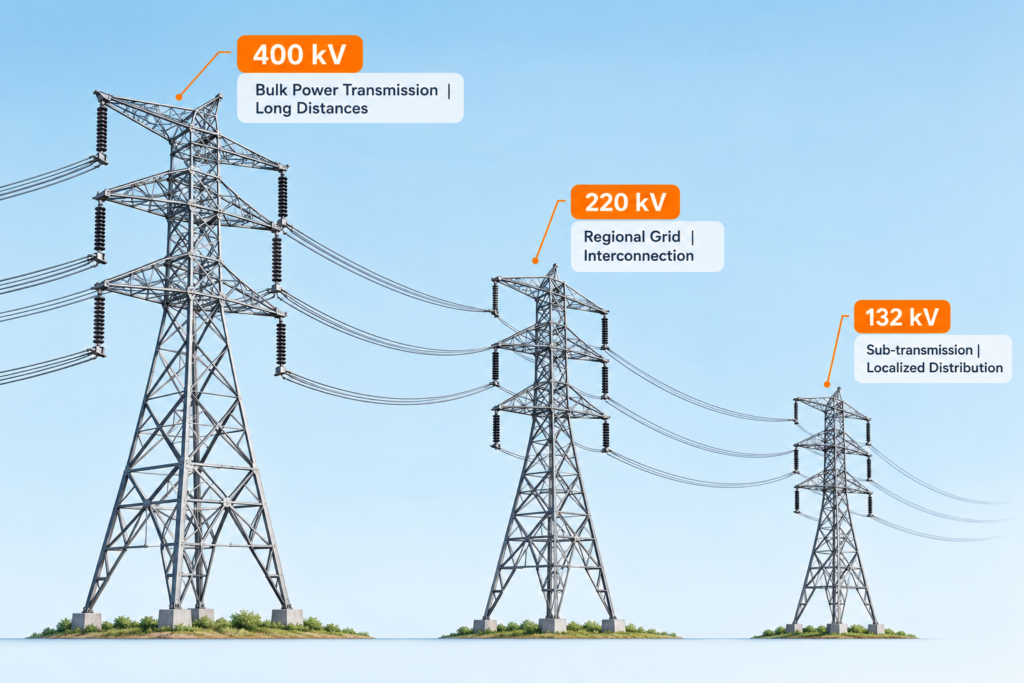
If you have ever traveled across the countryside or observed utility lines near industrial corridors, you might have noticed transmission towers differing drastically in height, cross-arm configurations, and conductor bundles. These visible structural variations are not random; they directly correspond to specific high-voltage tiers operating within the grid architecture: 400 kV, 220 kV, and 132 kV. In this comprehensive technical guide, we will analyze why these precise voltage tiers are vital for modern power transmission and how they collectively ensure uninterrupted grid stability.
The Fundamental Physics Behind High-Voltage Power Transmission
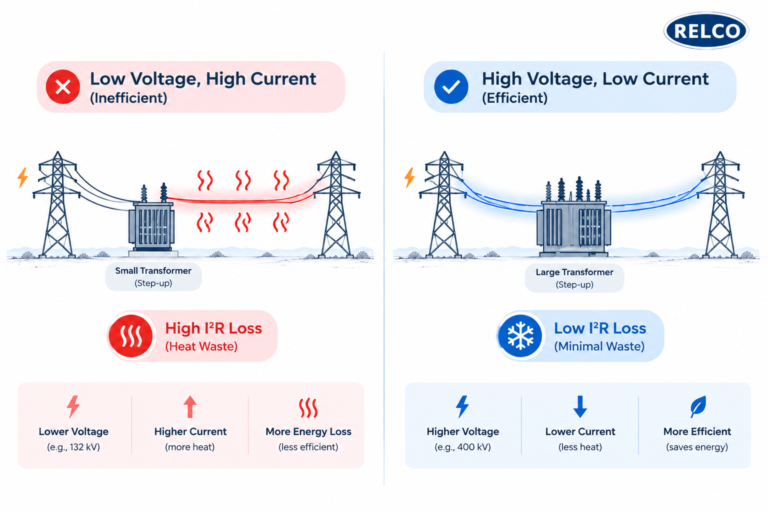
To understand why multiple voltage levels exist, one must first examine the fundamental laws of electrical physics—specifically, Joule heating and resistive power losses (I²R losses). When electric current (I) passes through any physical transmission conductor possessing internal electrical resistance (R), a portion of that electrical energy is inevitably dissipated into the atmosphere as thermal heat energy.
Mathematically, the power loss formula is expressed as Ploss = I² × R. Because the power loss is proportional to the square of the current, even a relatively small increase in current results in massive exponential waste over long distances.
Simultaneously, the fundamental relationship of electrical power states that P = V × I (where P is total power transferred, V is voltage, and I is current). To transmit a massive block of power across vast regions without melting conductors or suffering catastrophic energy drop-offs, power system engineers use step-up transformers at generation sites to elevate the voltage (V) to extreme heights, which concurrently drives down the current (I) to minimal levels.
Deconstructing the Core Transmission Voltage Hierarchy
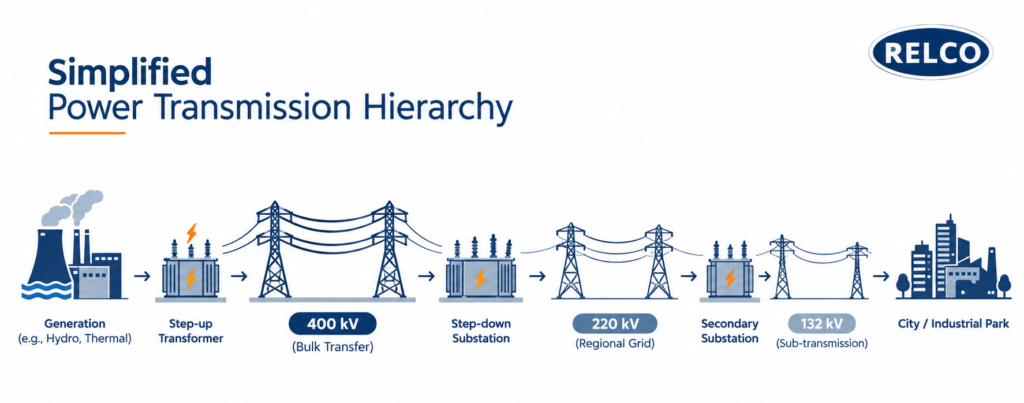
Once power is transmitted over long distances at ultra-high voltages, it cannot be fed directly into urban neighborhoods or standard industrial plants. The grid must systematically step down the voltage in progressive stages to match regional demands, sub-station capacities, and safety thresholds.
1. 400 kV: The High-Capacity Backbone for Long-Distance Bulk Transfer
- The Core Purpose: The 400 kV tier represents an ultra-high voltage (UHV/EHV) classification utilized primarily as the heavy-duty backbone of regional and national power grids. It is engineered explicitly for bulk power transmission over very long distances.
- Operational Application: These towering lattice structures and thick conductor bundles carry massive blocks of electricity—often measured in gigawatts—from mega-generation stations directly to major metropolitan load centers and interstate transmission rings.
- Engineering & Economic Impact: Operating at 400 kV allows transmission utilities to minimize cross-sectional conductor requirements while moving massive energy volumes across state borders, ensuring minimal thermal degradation and optimal economic viability over long spans.
2. 220 kV: Regional Transmission and Inter-Grid Interconnection
- The Middle Tier: As bulk power flows inward from national transmission corridors and approaches regional boundaries, it transitions into the 220 kV network tier.
- Operational Application: 220 kV lines function as critical high-capacity regional arteries. They interconnect primary substations, large manufacturing clusters, and independent regional power pools into a unified synchronous network.
- Grid Stability and Redundancy: This intermediate tier provides essential load balancing and operational redundancy. If a major generation unit experiences an unexpected trip or localized demand surges drastically, 220 kV interconnectors allow system operators to dynamically reroute power flows across neighboring zones to prevent cascading blackouts.
3. 132 kV: Sub-Transmission and Distribution to Heavy Industries
- The Sub-Transmission Link: As electricity penetrates deeper into urban perimeters and heavy industrial sectors, the voltage is further stepped down to the 132 kV level.
- Operational Application: 132 kV lines supply power directly to secondary substations, heavy metallurgical plants, railway traction sub-stations, and large commercial manufacturing complexes.
- Bridging the Gap: This crucial tier forms the direct bridge between high-voltage bulk transmission networks and the lower-voltage distribution systems that ultimately serve medium commercial and residential sectors.
Key Takeaway: The gradual step-down progression from 400 kV down to 220 kV and 132 kV is a meticulously engineered hierarchy designed to maximize transmission efficiency, suppress thermal losses, and guarantee absolute grid reliability under fluctuating load conditions.
The Critical Role of Resilient Electrical Infrastructure
Designing, erecting, and sustaining a multi-tiered power transmission network demands uncompromising engineering standards, high-reliability equipment, and durable overhead line materials. From heavy-duty aluminum conductor steel-reinforced (ACSR) lines and composite insulators to structural steel towers engineered to withstand severe wind loads and extreme weather events, every individual component plays an indispensable role in preventing grid failure and maximizing uptime.
At Relco Electricals, we specialize in delivering advanced engineering solutions, technical execution capabilities, and robust infrastructure components for high-voltage power transmission and distribution networks. Whether supporting complex cross-country grid expansions or strengthening regional sub-transmission assets, our core commitment remains centered on driving reliable, highly efficient electrical engineering solutions for the future of power systems.
About the Author:
Meghna Baid is a marketing professional with 7 years of experience, specializing in the electrical industry. She excels in brand building, strategic messaging, and high-impact campaigns, blending creativity with data-driven precision. With a sharp understanding of B2B and technical markets, she crafts compelling narratives that drive results and build strong industry connections.
Reach out to her at marketing@relcoelectrical.com
Related posts
Understanding High-Voltage Disconnector Switches: Types, Functions, and Maintenance Best Practices
About Us
RELCO Electricals excels in engineering resilience for global power infrastructure, providing the technical precision and high-voltage safety solutions required to safeguard critical energy networks throughout their entire operational lifecycle.
Quick Link
Contact Us
- +91-8447317403, 9999904753
- media@relcoelectrical.com
- Ground Floor, Industrial Park, Block C, Plot No. 548, Narela, New Delhi, Delhi 110040
Relco Electricals
Typically replies within minutes
Hi from Relco Electricals!
Supporting India’s power grid since 1995. Looking for a custom quote for portable earthing devices or live-line equipment? Tell us your project requirements below.
WhatsApp Us
Online | Privacy policy
WhatsApp us