Not All Power Lines Behave the Same

0
Not All Power Lines Behave the Same

Power Systems Engineering • Transmission Lines • 8 min read

Electricity powers every part of modern life — from hospitals and data centres to homes and factories. Before it reaches consumers, energy must travel through a vast network of transmission lines, substations, and transformers. But while most lines look identical from the outside, their electrical behaviour is anything but.

At first glance, a transmission line is simply a conductor strung between towers. Electrically, however, the story is far more nuanced. The behaviour of a transmission line changes fundamentally with distance, operating voltage, and the underlying electrical parameters of the conductor itself.

As transmission distance grows, effects that were once negligible start to dominate the system. This is why power engineers classify transmission lines into distinct categories — and why each category demands a different mathematical model.

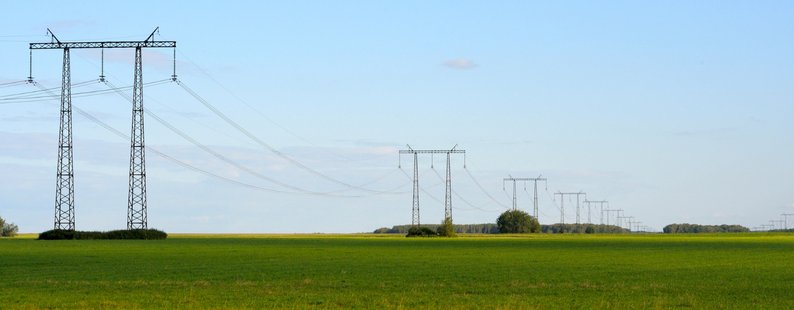
High-voltage transmission towers

High-voltage transmission towers stepping electricity down from power stations toward distribution networks.

Why Classification Matters?

A transmission line carries three inherent electrical parameters distributed along its entire length: resistance, inductance, and capacitance. Each one shapes how voltage behaves, how much power is lost, and how stable the system remains under varying loads.

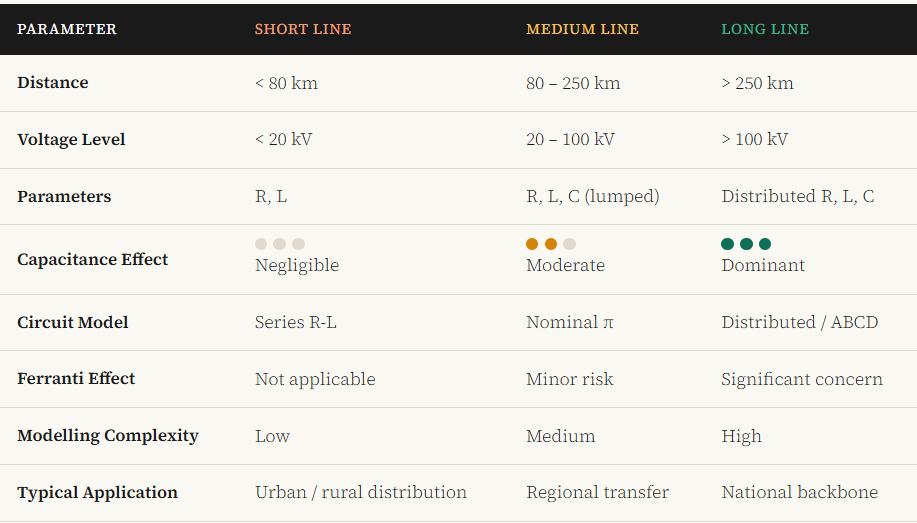
The relative influence of these parameters shifts dramatically with line length. On a short local line, capacitance barely registers. On a 500 km inter-regional corridor, it can cause voltage to rise dangerously under light-load conditions — a phenomenon engineers must plan for carefully.

Getting the model right isn't academic — it directly affects voltage regulation, protection coordination, loss reduction, and system stability. As national grids grow larger and increasingly interconnected, accurate classification is more important than ever.

The Three Parameters That Define a Line

Resistance

Caused by the conductor material opposing current flow. Produces heat losses, voltage drop, and reduced efficiency. Increases with line length and temperature.

Inductance

Created by the magnetic field surrounding any current-carrying conductor. Opposes changes in current, causes reactive voltage drop, and influences power factor and stability.

Capacitance

Arises from conductors separated by air above ground. Generates charging current and reactive power even with no load — increasingly dominant on longer lines.

The interplay between these three parameters changes as distance grows. Short lines can ignore capacitance entirely. Medium lines must include it. Long lines require a fundamentally different mathematical framework — distributed parameter analysis — because R, L, and C can no longer be treated as concentrated at a single point.

"The longer the line, the more complex the behaviour — and that is exactly why not all power lines behave the same."

Short Transmission Lines

01  Short Transmission Line

Up to 80 km  ·  Below 20 kV  ·  R + L model only


< 80 km

Max Length

< 20 kV

Voltage Level

R, L

Parameters Used

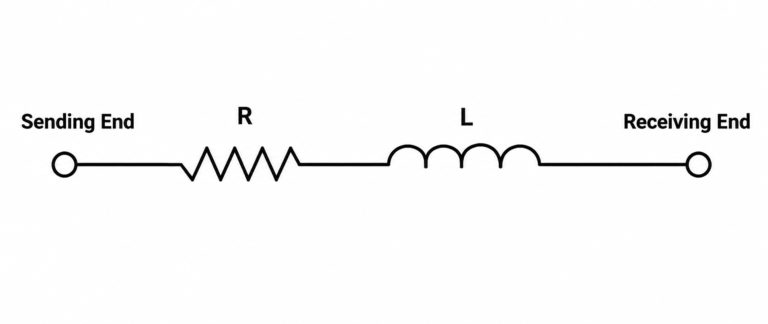
Because the line is relatively short, capacitive charging current is tiny and can safely be ignored. Engineers use a simple series model — resistance and inductance in series — making analysis straightforward.

Short lines are the workhorses of local and urban power delivery. They're cheaper to insulate, easier to protect, and simpler to analyse. The trade-off is that they carry lower power densities — more current must flow for the same power level, increasing losses over any significant distance.

Equivalent circuit — series R-L model

Electrical substations step voltage up or down between transmission levels, forming the backbone of regional grid infrastructure.

Medium Transmission Lines

02 Medium Transmission Line

80 – 250 km  ·  20 – 100 kV  ·  Nominal π model

80–250 km

Length Range

20–100 kV

Voltage Level

R, L, C

Parameters Used

Nominal π model — capacitance split at each end

On medium lines, three new phenomena emerge that engineers must account for:

Charging Current
Flows even under light load due to line capacitance
Voltage Rise
Receiving-end voltage can exceed sending-end at light loads
Reactive Power
Line starts generating reactive power, influencing system stability

Long Transmission Lines

03 Long Transmission Line

Over 250 km  ·  Above 100 kV  ·  Distributed parameters

250 km

Minimum Length

100 kV

Voltage Level

Distributed

Parameter Model

For long lines, the lumped-parameter assumption breaks down entirely. Resistance, inductance, and capacitance are distributed continuously along every metre of the conductor. Voltage and current vary throughout the line, and wave propagation effects become significant.
Distributed parameter model — infinite cascade of R-L-C segments

⚡ The Ferranti Effect

Under light-load or no-load conditions on a long line, the receiving-end voltage can exceed the sending-end voltage. This counterintuitive phenomenon — named after electrical engineer Sebastian Ziani de Ferranti — occurs because dominant capacitive charging current flows through the line's inductive impedance, producing a voltage rise. It becomes more pronounced the longer the line, and must be controlled using shunt reactors or other compensation equipment.

Long-distance transmission also introduces synchronisation challenges, power oscillations, and voltage instability risks. Engineers use advanced tools — shunt reactors, series compensation, FACTS devices, and real-time computer simulation — to keep these lines stable.

How Capacitance Grows with Distance?

Perhaps the single most important concept in transmission line classification is the increasing dominance of capacitance as distance grows. What begins as a negligible nuisance becomes the controlling factor in system behaviour.

Relative influence of capacitive effects on total system behaviour by line length category.

Side-by-Side Comparison

Integrating renewable energy sources into national grids demands ever-longer transmission corridors — making accurate line classification more critical than ever.

Integrating renewable energy sources into national grids demands ever-longer transmission corridors — making accurate line classification more critical than ever.

Why This Knowledge Matters Today?

Modern power systems are undergoing rapid transformation. The push toward renewable energy — wind farms in remote regions, solar parks in deserts, offshore installations hundreds of kilometres from shore — means electricity must increasingly travel vast distances before it reaches consumers.

At the same time, national grids are becoming more interconnected, allowing countries to trade electricity across borders and balance variable renewable output over wider areas. Both trends increase average transmission distances and raise the stakes for accurate modelling.

Getting the model wrong has real consequences: voltage collapse, protection miscoordination, power quality degradation, or — in the worst case — widespread blackouts. Proper classification and modelling helps engineers design compensation strategies, optimise reactive power flow, and keep the grid stable as its complexity grows.

Whether it is a short urban feeder delivering power to a hospital, a medium inter-city link connecting two regional grids, or a 500 kV backbone corridor stretching across a continent — each behaves according to its own electrical logic. Understanding those differences is the foundation of every reliable, efficient power system ever built.

About the Author:

Meghna Baid

Meghna Baid is a marketing professional with 7 years of experience, specializing in the electrical industry. She excels in brand building, strategic messaging, and high-impact campaigns, blending creativity with data-driven precision. With a sharp understanding of B2B and technical markets, she crafts compelling narratives that drive results and build strong industry connections.

Reach out to her at marketing@relcoelectrical.com

Related Post:https://www.linkedin.com/feed/update/urn:li:activity:7458470918735138816

Leave a Reply

Your email address will not be published. Required fields are marked *