


The Hidden System That Keeps Your Power Stable

0
The Hidden System That Keeps Your Power Stable

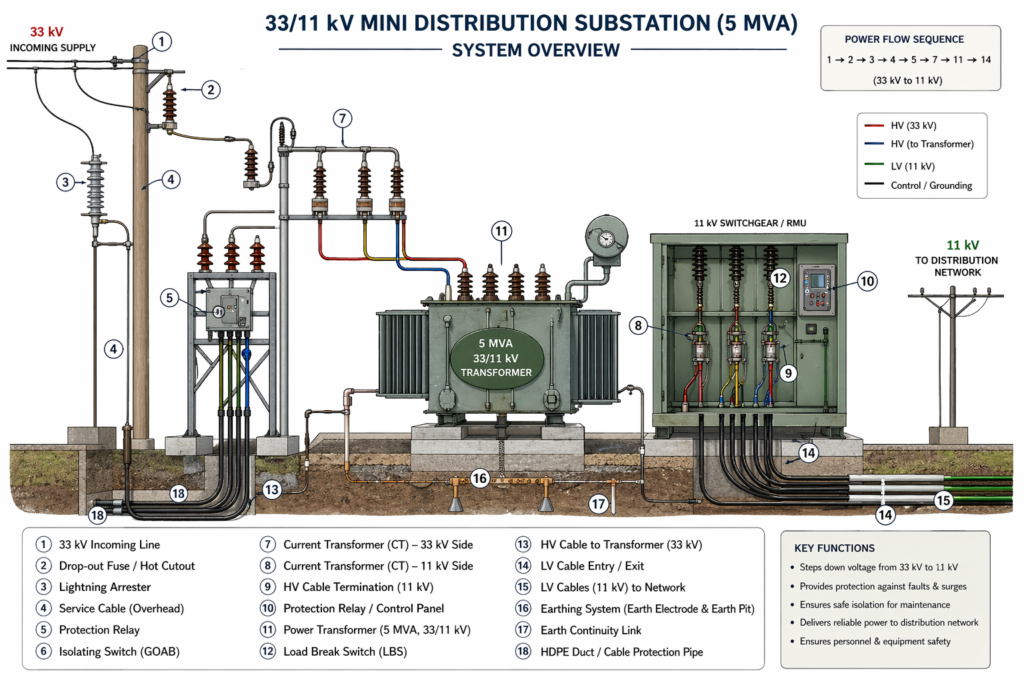
Electricity is often taken for granted. A switch is flipped, and power is instantly available. But behind this seamless experience lies a carefully engineered network of components working together around the clock.One of the most crucial — yet least visible — nodes in this network is the Mini Primary Distribution Substation (5 MVA, 33/11 kV). Though compact in structure, it performs multiple critical functions: voltage transformation, fault protection, system stability, and continuous monitoring.

Mini Primary Distribution Substation (5 MVA, 33/11 kV)
Typical power journey

Typical power journey from the national grid to end users

Section 01

The Real Purpose of a Distribution Substation

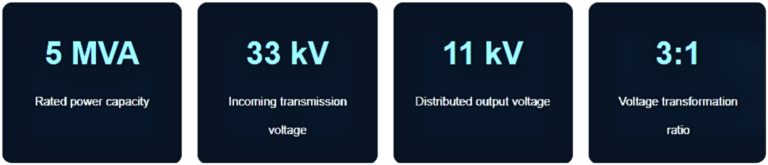
At first glance, the role of a distribution substation appears straightforward: reduce voltage from 33 kV to 11 kV, making it suitable for local distribution networks. But this is only one dimension of its function.

A simplified view of how electricity flows from generation to end consumers via substations

A simplified view of how electricity flows from generation to end consumers via substations

the role of a distribution substation

In practice, the substation also acts as a control point, a protection layer, and a reliability enhancer within the electrical grid. Without such substations, power systems would be far more vulnerable to outages, voltage instability, and equipment damage.

Section 02

Understanding Power Flow Through the System

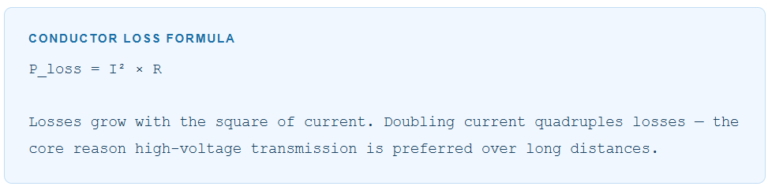
Electricity arrives at 33 kV through overhead conductors. At this stage, the system is designed to transmit power efficiently over distances while keeping losses low. The key insight is that high voltage enables low current — and low current means dramatically lower transmission losses.

Overhead conductors and pole-mounted transformers are a common sight in the distribution network.

"Since losses in conductors depend on the square of the current, keeping current low at high voltage significantly improves transmission efficiency."
Three-Phase Current Formula

The relationship between power, voltage, and current in a three-phase system follows this fundamental equation.

For a 5 MVA system at 33 kV, this results in a current of approximately 87 amperes on the high-voltage side. After transformation to 11 kV, the current rises to approximately 262 amperes — a direct consequence of Kirchhoff's power conservation principle.

Why does this matter? 
Higher current on the low-voltage side means thicker conductors are required, insulation must be more robust, and heat dissipation becomes a critical engineering challenge. Every design choice downstream of the transformer is shaped by this current increase.
Section 03

The First Line of Defense: Protection Systems

Before power reaches the transformer, it passes through multiple layers of protection designed to handle abnormal conditions. Electrical systems are frequently exposed to transient events — lightning strikes, switching surges, equipment faults — that can cause voltage spikes severe enough to destroy insulation and equipment.

SF₆ gas-insulated circuit breakers are widely used in modern high-voltage substations for their superior arc-quenching properties

Four key protection elements define modern substations:

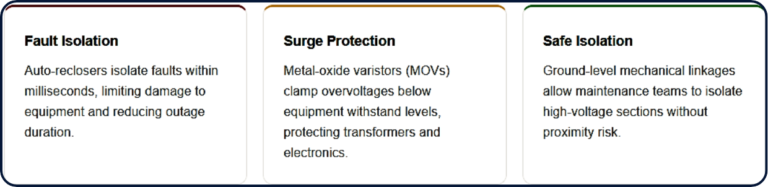
  • Surge Arresters: Provide an ultra-fast alternate path for excess voltage, directing energy safely into the earth. They respond in nanoseconds — fast enough to protect semiconductor-based control equipment from damage.
  • Auto-Reclosing Circuit Breakers: Unlike traditional breakers requiring manual reset, modern systems detect faults and respond autonomously. After a short delay, the breaker attempts to restore supply — particularly effective for temporary faults caused by tree branches or wildlife contact.
  • Isolating Switches (Disconnectors): Allow complete de-energization of equipment sections for safe maintenance. Designed to operate all three phases simultaneously, many can be operated from ground level via mechanical linkages, reducing personnel risk.
  • Current Transformers (CTs) & Voltage Transformers (VTs): Scale down high-power signals to safe measurement levels, feeding data to protection relays and metering systems.
The First Line of Defense: Protection Systems
Section 04

Voltage Transformation: The Core Process

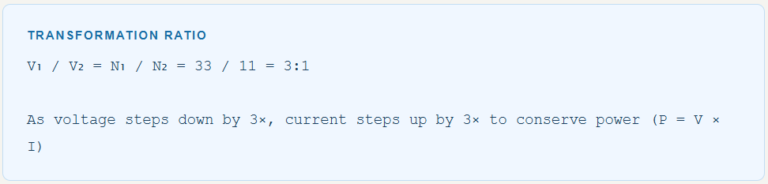
After passing through protection and switching elements, electrical power reaches the transformer — the heart of the substation. The transformer's role is elegantly simple in principle: it uses electromagnetic induction to change voltage levels with very high efficiency, typically exceeding 98–99%.

Transformation Ratio

Distribution transformers step voltage down to levels suitable for local networks — a core function of every substation

Modern distribution transformers use On-Load Tap Changers (OLTCs) — mechanical devices that adjust the transformer's turns ratio while the transformer remains energized. This allows operators to fine-tune output voltage in response to fluctuating load conditions, maintaining voltage within ±5% of nominal levels even as demand changes throughout the day.

"A well-designed power transformer can remain in service for 30–40 years, making it one of the most long-lived assets in the entire electrical grid."
Section 05

Power Quality and Efficiency

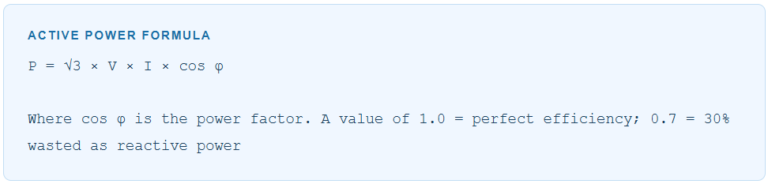
Not all electrical power drawn from the grid is converted into useful work. The proportion of usable power is characterized by the power factor — a dimensionless value between 0 and 1 that represents how efficiently electrical energy is being used.

Active Power Formula

Industrial equipment such as motors, welding machines, and large HVAC systems naturally introduce reactive power into the grid, reducing the effective power factor. Distribution substations often incorporate capacitor banks or Static VAR Compensators (SVCs) to counteract this effect and bring power factor closer to unity.

Conductor Loss Formula
  • A power factor of 0.8 means 20% of apparent power is wasted circulating as reactive current
  • Utilities often impose financial penalties on industrial customers with poor power factor (<0.9)
  • Capacitor banks at substations can correct power factor passively, reducing current draw from the grid
  • Modern smart meters can detect power factor in real time, enabling dynamic compensation
Section 06

Control Systems and Automation

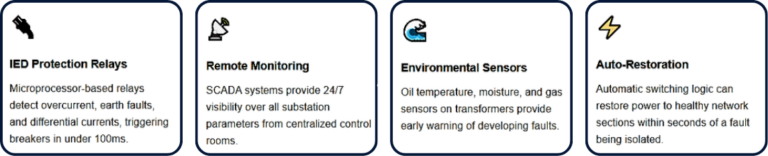
Modern substations are far from passive equipment enclosures. They are sophisticated monitoring and control nodes within a wider intelligent grid. SCADA (Supervisory Control and Data Acquisition) systems allow operators to monitor hundreds of parameters — voltage, current, temperature, equipment status — from a central control room, often located kilometers away.

Modern SCADA panels enable real-time remote monitoring and control of substation equipment

Intelligent Electronic Devices (IEDs) embedded in protective relays continuously analyze electrical parameters and can trigger protection responses faster than any human operator — typically within 20–100 milliseconds of a fault being detected.

Control Systems and Automation
Section 07

Grounding: A Critical Safety Mechanism

An effective earthing (grounding) system is essential for both operational safety and equipment protection. During faults or surge events, excess current must be safely directed into the earth — a task that requires maintaining very low earth resistance, typically below 1 ohm for primary substations.

A buried copper earthing grid under the substation yard provides a low-resistance path for fault currents

The grounding system serves three distinct purposes: protecting personnel from dangerous touch and step voltages during faults, providing a reference potential for the electrical system, and enabling protective relays to detect earth faults reliably so they can respond appropriately.

Step voltage hazard:
During a ground fault, current spreading through the earth creates dangerous voltage gradients on the soil surface. A grounding grid equalizes potential across the substation yard, limiting step and touch voltages to safe levels for personnel — even during a major fault event.
Section 08

Why This System Delivers High Reliability

The reliability of a mini primary distribution substation emerges from the tight integration of multiple systems working together seamlessly. No single component is responsible for uptime — it is the layered, redundant design that makes the system robust.

  • High-voltage transmission reduces current magnitude, minimizing I²R losses over long distances
  • Rapid auto-reclosing restores supply within seconds for transient faults, reducing customer outage time
  • Redundant protection systems (primary and backup relays) ensure faults are always isolated, even if one relay fails
  • Insulated bundled conductors reduce likelihood of environmental contact faults in urban and vegetation-rich areas
  • Continuous SCADA monitoring enables proactive maintenance before equipment failures occur
  • Properly designed earthing ensures all protection systems operate effectively and personnel remain safe
Why This System Delivers High Reliability

About the Author:

Meghna Baid

Meghna Baid is a marketing professional with 7 years of experience, specializing in the electrical industry. She excels in brand building, strategic messaging, and high-impact campaigns, blending creativity with data-driven precision. With a sharp understanding of B2B and technical markets, she crafts compelling narratives that drive results and build strong industry connections.

Reach out to her at marketing@relcoelectrical.com

Related Post:

https://www.linkedin.com/posts/relcoelectricals_relcoelectriclas-powerdistribution-substation-activity-7452944357705560065-MPoW?utm_source=share&utm_medium=member_desktop&rcm=ACoAAGBsbV0BgqM83w3WJYKBcPOnBTMWNj8ZaMc

Leave a Reply

Your email address will not be published. Required fields are marked *