Why 3-Phase Systems Are Preferred Over Single-Phase in Electrical Engineering?

0

1. Introduction

Single-phase power is the standard supply for residential environments — powering lighting, fans, air conditioners, and small household appliances. It is economical, simple to distribute, and entirely sufficient for low-power demands.However, in industrial environments where heavy machinery, large motors, and continuous-process equipment are involved, single-phase systems are rarely used. Engineers overwhelmingly rely on 3-phase systems for all medium and high-power applications.

This blog answers the fundamental question: if single-phase systems are capable of supplying power, why are 3-phase systems universally preferred in engineering applications?

Key Insight
The preference for 3-phase power is not simply about delivering greater quantities of power. It is about delivering power in a stable, continuous, and efficient manner — attributes that are critical for industrial machinery, transmission infrastructure, and high-reliability systems.

2. Understanding Single-Phase Power

In a single-phase AC system, voltage and current vary sinusoidally with time. The instantaneous power delivered to a resistive-reactive load is given by:

Instantaneous Power — Single-Phase System

P(t) = V · I · cosφ · (1 + cos 2ωt)

Where: V = RMS Voltage,  I = RMS Current,  cosφ = Power Factor,  ω = Angular Frequency (2πf)

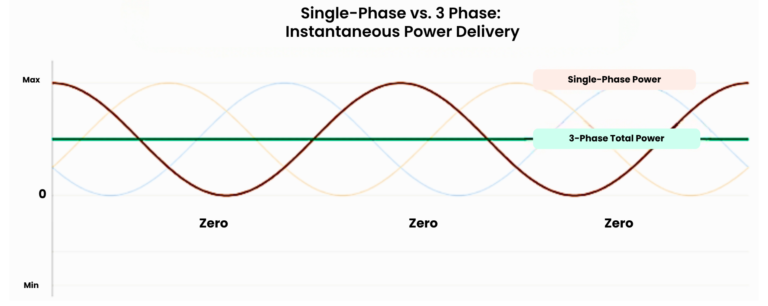
Single-Phase vs. 3 Phase: Instantaneous Power Delivery

The critical term in this equation is cos(2ωt). This creates a power oscillation at twice the supply frequency. In a 50 Hz system, power pulsates 100 times per second, dropping to zero at each cycle crossing. That is the root cause of every single-phase limitation.

2.1  Consequences of Pulsating Power

The pulsating nature of single-phase power has three direct consequences:

  • Power drops to zero twice in every cycle — no energy is transferred at these instants.
  • Energy delivery is discontinuous — the load receives alternating bursts of energy rather than a steady flow.
  • Torque in motors is directly proportional to instantaneous power, so torque also pulsates.
Torque–Power Relationship
Since mechanical torque in an electric motor is proportional to instantaneous electromagnetic power (Torque Power), any fluctuation in delivered power produces a proportional fluctuation in shaft torque. In a single-phase motor running at 50 Hz, torque ripples 100 times per second — causing the shaft to lurch rather than rotate smoothly.

2.2  Effects on Electrical Machines

Torque pulsation in single-phase motors produces several practical problems that reduce equipment performance and longevity:

  • Vibrations: The motor shaft does not rotate smoothly, generating cyclic mechanical vibrations throughout the drivetrain.
  • Acoustic noise: Vibrations radiate as audible humming and buzzing, unacceptable in many industrial environments.
  • Accelerated wear: Bearings, shafts, and couplings are subjected to repetitive impact forces that accelerate fatigue failure.
  • Reduced efficiency: Energy is dissipated as heat and vibration rather than useful mechanical output.
  • Operational instability: Precision processes cannot tolerate torque ripple.

3. The 3-Phase Solution

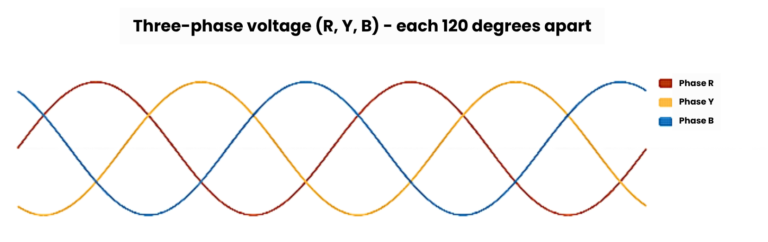
A 3-phase system generates three sinusoidal voltages — Phase R, Phase Y, and Phase B — each identical in magnitude and frequency but displaced by exactly 120° from one another. The total instantaneous power delivered by a balanced 3-phase system is:

Total 3-Phase Power (Balanced Load)

P_total = √3 · V_L · I_L · cosφ  =  constant

Three-phase voltage (R, Y, B) - each 120 degrees apart

The key result is that the total power is constant — it contains no oscillating term. This fundamental difference from single-phase power eliminates all the problems described in Section 2.

3.1 Why Power Remains Constant

The sum of three sinusoidal power functions displaced by 120° from each other is algebraically constant. When Phase R is at its minimum, Phases Y and B are rising to compensate. The three phases act as a perfectly self-balancing energy delivery system — at every instant, at least one phase is delivering near-maximum power, and no phase ever leaves the load completely un-energised.

3.2  Impact on Motor Performance

Because torque is proportional to instantaneous power, and 3-phase power is constant, a 3-phase induction motor produces perfectly uniform torque. The practical benefits are substantial:

  • Smooth, vibration-free rotation — no torque ripple, no shaft lurching.
  • Significantly reduced acoustic noise — 3-phase motors run near-silently compared to single-phase equivalents.
  • Extended component life — bearings and gearboxes experience uniform loading rather than repeated impact.
  • Higher power density — a 3-phase motor of a given frame size produces more usable power.
  • Inherent self-starting — the rotating magnetic field starts the rotor without auxiliary capacitors or windings.

4. Transmission and Distribution Advantages

4.1  Reduced Conductor Material

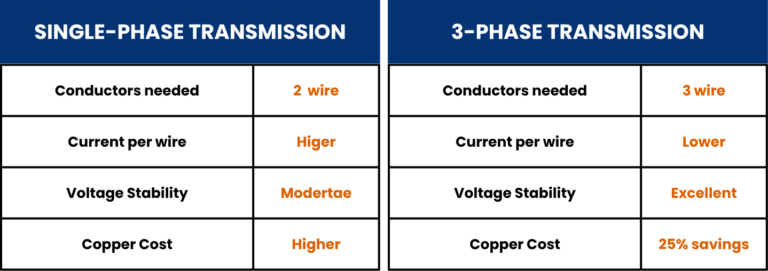
For the same transmitted power, a 3-phase system carries approximately 57.7% of the current that an equivalent single-phase system requires. With three conductors (vs. two for single-phase), total conductor material is reduced by approximately 25% for the same power and voltage drop.

Conductor Loss Formula

P_loss = I² · R

Because current is lower in each 3-phase conductor, ohmic losses (I²R) are significantly reduced. Over a high-voltage transmission line spanning hundreds of kilometres, this represents enormous savings in capital cost and ongoing energy waste.

4.2  Voltage Regulation

Three-phase systems maintain more stable terminal voltage under varying load conditions. In a balanced 3-phase system, load changes on any one phase are partially compensated by the other two, resulting in smaller voltage swings and improved power quality.

4.3  Generator and Transformer Economy

Three-phase generators, transformers, and switchgear are inherently more efficient and compact than equivalent single-phase equipment. A 3-phase transformer uses a shared core for all three windings, reducing iron losses and physical size.

5.  Detailed Comparison: Single-Phase vs. 3-Phase

The table below summarises the key technical differences across all major performance parameters.

Comparison of single-phase and three-phase transmission
Comparison of single-phase and three-phase systems

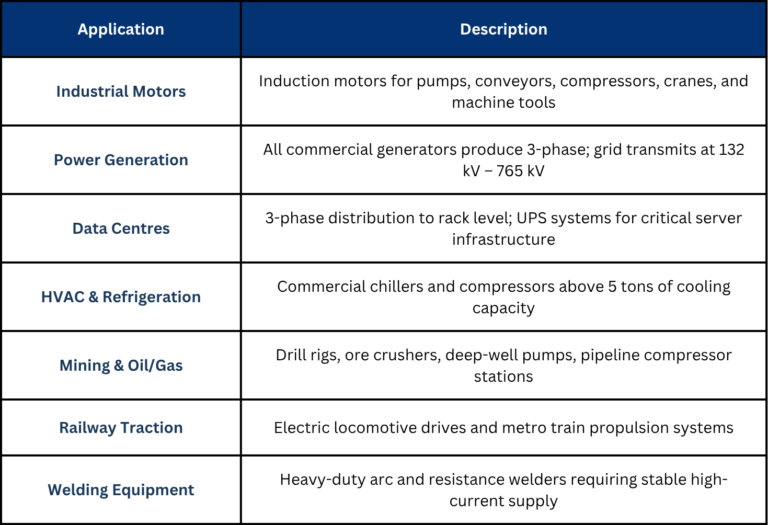
6. Industrial and Commercial Applications

Three-phase power is the preferred supply for all medium and high-power industrial and commercial applications.

Industrial and Commercial Applications

7. Conclusion

Single-phase systems are simple and cost-effective for low-power applications and will remain the standard for residential supply. However, their pulsating power delivery makes them fundamentally unsuitable for industrial and commercial environments.

Three-phase systems overcome every limitation of single-phase power by providing:

  • Constant instantaneous power — eliminating torque pulsation and enabling smooth ssmotor operation.
  • Higher transmission efficiency — lower current per conductor reduces I²R losses substantially.
  • Reduced infrastructure cost — approximately 25% less conductor material for equivalent power capacity.
  • Greater reliability — stable voltage regulation under varying industrial loads.
  • Superior motor characteristics — self-starting, compact, higher power-to-weight ratio.
Summary
Three-phase power does not merely deliver more energy than single-phase — it delivers energy in a form that industrial machinery, grid infrastructure, and critical systems can efficiently use. The 120° phase separation produces a perfectly balanced, continuous power flow that is the foundation of every modern electrical grid, factory, data centre, and high-power installation worldwide.

About the Author:

Meghna Baid

Meghna Baid is a marketing professional with 7 years of experience, specializing in the electrical industry. She excels in brand building, strategic messaging, and high-impact campaigns, blending creativity with data-driven precision. With a sharp understanding of B2B and technical markets, she crafts compelling narratives that drive results and build strong industry connections.

Reach out to her at marketing@relcoelectrical.com

Related Post:

https://www.linkedin.com/feed/update/urn:li:activity:7447878600571342848

Leave a Reply

Your email address will not be published. Required fields are marked *