
Not All Transmission Towers Are Built the Same

0
Not All Transmission Towers Are Built the Same

Power Systems Engineering • Transmission Infrastructure • 10 min read • Structural & Electrical Design

Electricity travels hundreds of kilometres before it reaches homes, hospitals, and factories. The conductors carry the current — but it is the towers that hold the entire network together. And while they may look alike from a distance, every transmission tower is precisely engineered for a specific role.

Tower design is shaped by terrain, route alignment, voltage level, mechanical loading, and power transfer requirements. A structure that works perfectly on a straight rural corridor would be entirely inadequate at a river crossing or a sharp directional turn. That is why transmission systems use a wide family of tower types rather than one universal design.

In this blog we explore how transmission towers are classified, what engineering challenges each type solves, and why getting tower selection right is fundamental to a safe, stable, and efficient power grid.

Tower designs

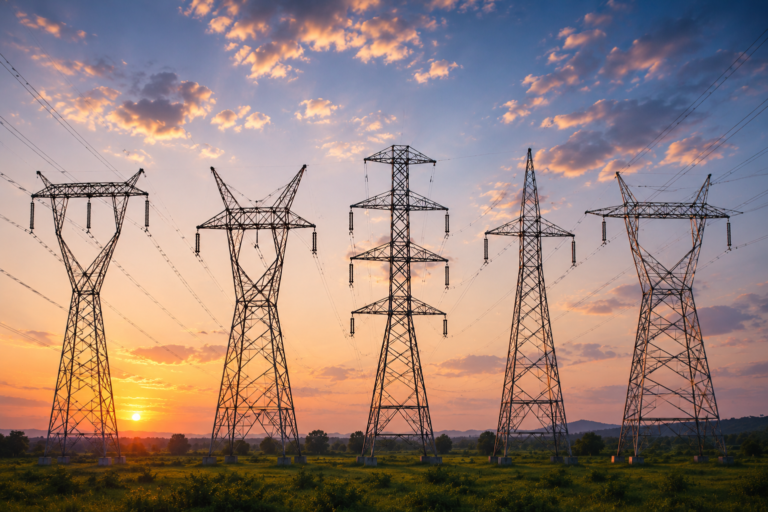
Transmission towers carry high-voltage conductors over long distances, supporting the electrical backbone of modern civilisation.

WHAT IS A TRANSMISSION TOWER?

A transmission tower is a tall steel structure whose job is to hold overhead conductors safely above the ground, maintain correct spacing between phases, and resist every mechanical force the environment can throw at it — wind, ice, conductor tension, and seismic loading.

Almost all transmission towers are fabricated from galvanised steel, which offers exceptional strength, corrosion resistance, and a service life measured in decades. The precise geometry of each tower — its height, leg spread, crossarm arrangement, and bracing pattern — is determined by detailed structural and electrical calculations before a single bolt is tightened on site.


Tower engineering is not a secondary consideration in grid design — it is the mechanical foundation on which electrical reliability is built.

WHY SO MANY DIFFERENT TYPES?

Transmission lines rarely travel in perfectly straight lines over flat, obstacle-free terrain. Route engineers must navigate rivers, mountain ranges, urban corridors, protected forests, and high-wind coastal zones. Each environment creates different mechanical and electrical demands.

A straight rural route needs economical, lightweight support structures. A river crossing may demand a tower over 100 metres tall. A 90-degree route deviation produces powerful side-pull forces that a standard suspension tower simply cannot handle. High-voltage inter-regional corridors may need to carry two full three-phase circuits on a single structure to minimise land use.

The result is a carefully developed taxonomy of tower types, classified by four main criteria: function, circuit configuration, structural form, and conductor geometry.

CLASSIFICATION BY FUNCTION

Suspension Tower

The Backbone of Any Long Straight Route

MOST COMMON

Usage

0°–2°

Deviation Angle

Vertical

Load Type

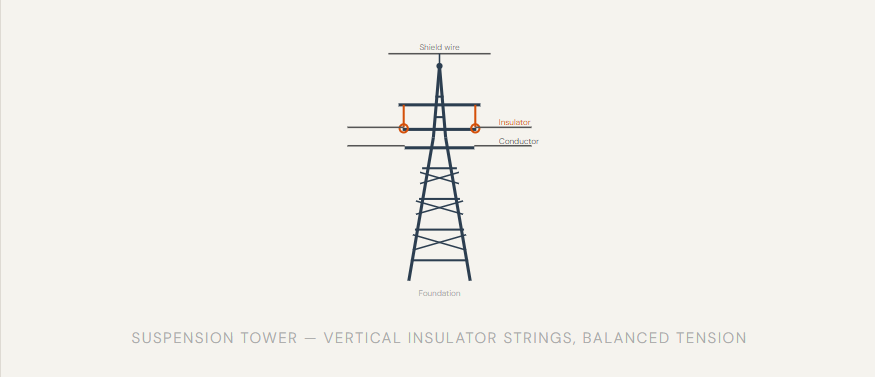
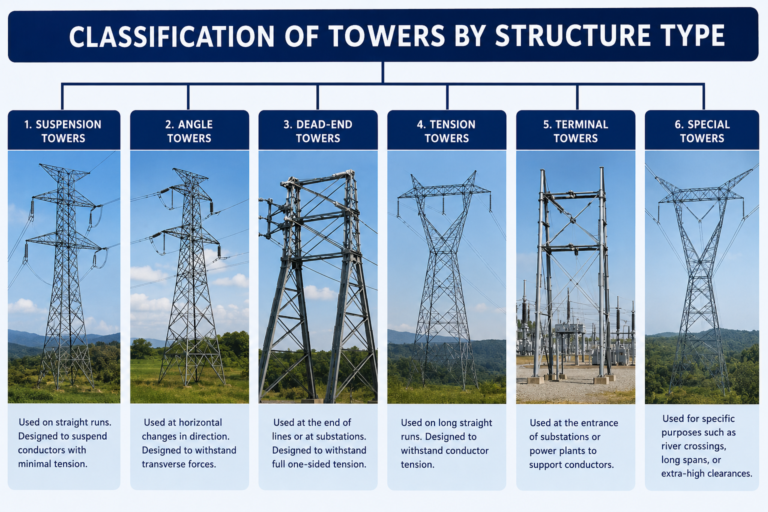
Suspension towers are the workhorse of any transmission system. Used on straight sections, they carry conductors on vertical suspension insulator strings, meaning tension on both sides of the tower is nearly equal. The structure primarily resists vertical conductor weight and lateral wind forces — not horizontal tension — allowing a lighter, more economical design.

Suspension tower

Because they only handle balanced loading, suspension towers use the least steel of any functional type — making them highly cost-effective for the long straight sections that make up the majority of any transmission route.

Long straight routes

Standard HV transmission

Lowest steel consumption

Angle Tower

Handling Directional Changes and Transverse Forces

2°–60°+

Deviation Angle

Side Pull

Primary Force

3 Types

Small / Med / Large

Wherever a transmission line changes direction, an angle tower is required. When conductors deviate from a straight path, the tension in the conductors creates a resultant side-pull force that acts perpendicular to the bisector of the angle. Standard suspension towers have no meaningful resistance to this transverse force — angle towers are reinforced specifically to handle it.

Angle towers are sub-classified by the magnitude of deviation: small-angle (typically 2°–15°), medium-angle (15°–30°), and large-angle (30°–60° or more). The greater the deviation, the heavier and more reinforced the structure must be.

Route deviations

Terrain-driven turns

Urban route changes

Tension Tower

Anchoring conductors against high horizontal tension

Strain

Insulator Type

Horizontal

Primary Force

Heavy

Construction

Unlike suspension towers where conductor tension balances across both sides, tension towers anchor conductors firmly using strain insulators arranged horizontally. This means the full tensile load of the conductor acts on one side of the structure, requiring substantially heavier steelwork and a wider, more stable base.

Tension towers are placed at regular intervals along a transmission line (typically every 5–10 suspension spans) to act as section points — limiting the distance over which a conductor break can cascade. They are also used wherever spans are unusually long or conductor tension is especially high.

Long spans

Mountainous terrain

Critical section points

Failure containment

Dead-End Tower

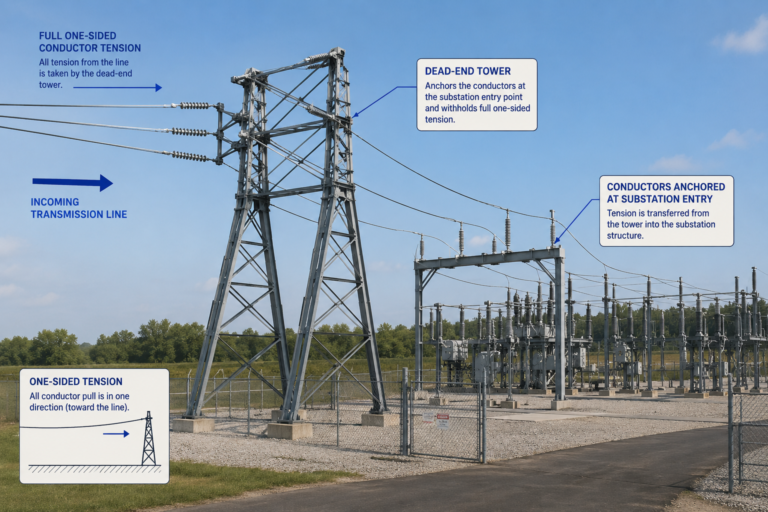
Installed at the termination of a transmission line — at substation entry points or where a major section ends. The tower anchors conductors from one side only, handling the full unbalanced tension of an entire line section. Often the most heavily loaded structure on a route.

River Crossing Tower

Extra-tall structures — sometimes exceeding 100 m — used where conductors must maintain regulatory clearance over wide rivers, valleys, or navigable waterways. The long unsupported span produces enormous conductor sag and tension, demanding extremely robust foundations and tower bodies.

Dead-end towers

Dead-end towers anchor conductors at substation entry points, withstanding full one-sided conductor tension from the incoming line.

CLASSIFICATION BY CIRCUIT CONFIRUGRATION 

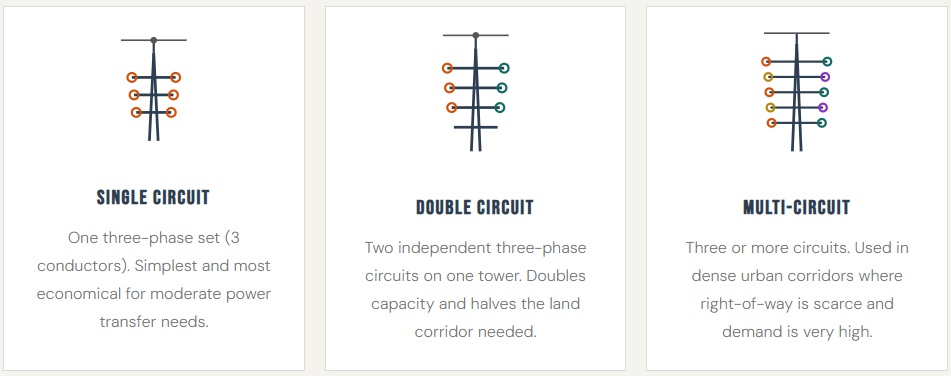
Beyond function, towers are also classified by how many independent electrical circuits they carry. This choice has major implications for transmission capacity, land use, and system reliability.

CLASSIFICATION BY CIRCUIT CONFIRUGRATION

The choice between single and double circuit has significant implications for grid resilience. A double-circuit tower carrying two circuits on one structure creates a potential single point of failure — if the tower falls, both circuits are lost simultaneously. Single-circuit routes offer physical independence at the cost of more land.

CLASSIFICATION BY STRUCTURE TYPE 

Classification by Structure Type

Lattice steel construction — the dominant structural form in transmission tower engineering — provides exceptional strength-to-weight ratio through its triangulated member arrangement.

Lattice Steel Tower

The dominant form worldwide. An open framework of triangulated steel angle sections, hot-dip galvanised for corrosion resistance. The triangulated geometry distributes loads efficiently, giving an excellent strength-to-weight ratio. All components can be bolted together on site without heavy lifting equipment.

Tubular Steel Tower

Uses hollow circular steel sections rather than open angle members. The closed cross-section provides better aerodynamic performance and a cleaner visual profile, making it well suited to urban and suburban settings where visual impact matters.

Monopole Tower

A single tapered steel tube, anchored in a concrete foundation. Monopoles have the smallest ground footprint of any tower type — critical in constrained urban environments. They are increasingly used for compact transmission corridors and distribution-level substations.

Tubular Steel Tower

Uses hollow circular steel sections rather than open angle members. The closed cross-section provides better aerodynamic performance and a cleaner visual profile, making it well suited to urban and suburban settings where visual impact matters.

CLASSIFICATION BY CONDUCTOR GEOMETRY

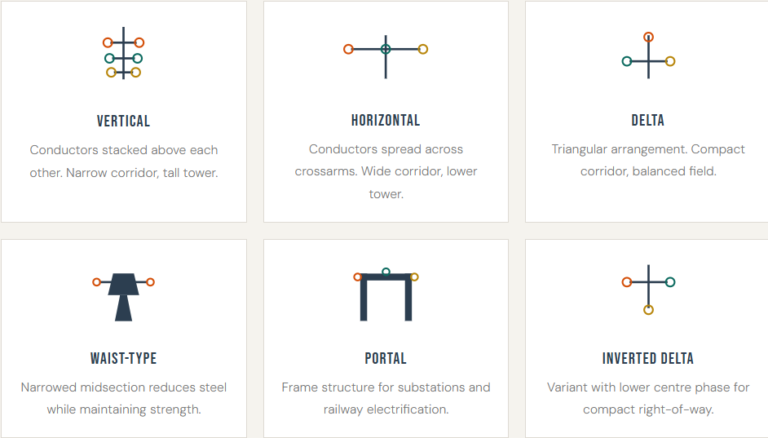
The final classification dimension concerns how conductors are physically arranged on the tower. This affects the electrical field between phases, the width of the right-of-way corridor, inductive coupling, and even magnetic field exposure at ground level.

Classification by Conductor Geometry

ENGINEERING IMPACT OF TOWER SELECTION

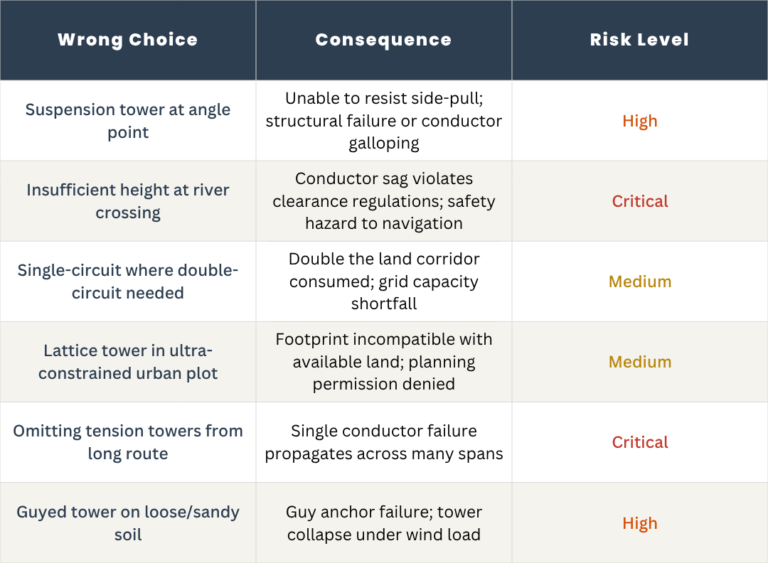
Choosing the wrong tower type for a given application is not merely an engineering inefficiency — it is a safety and reliability risk. Poor tower selection leads to a cascade of problems that can compromise an entire line section.

Engineering Impact of Tower Selection

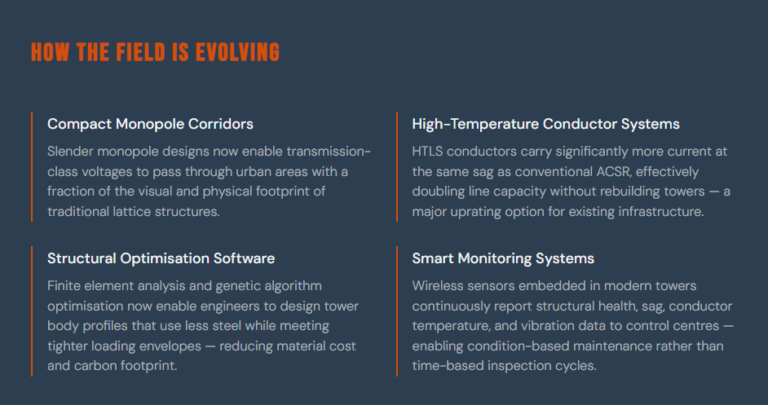
MODERN DEVELOPMENT IN TOWER ENGINEERING 

Modern Developments in Tower Engineering

The push toward renewable energy integration is also reshaping tower design. Offshore wind farms require specialised transition structures bridging subsea cable systems to overhead transmission. Long HVDC corridors linking remote solar and wind resources to urban demand centres demand bipole tower designs quite different from traditional AC structures.

The push toward renewable energy integration is also reshaping tower design. Offshore wind farms require specialised transition structures bridging subsea cable systems to overhead transmission. Long HVDC corridors linking remote solar and wind resources to urban demand centres demand bipole tower designs quite different from traditional AC structures.

Understanding which compromise has been struck — and why — is what separates a transmission engineer from someone who merely installs steel in the ground. The grid that powers modern life depends entirely on these decisions being made correctly, the first time, for structures that may stand for 50 years or more.

About the Author:

Meghna Baid

Meghna Baid is a marketing professional with 7 years of experience, specializing in the electrical industry. She excels in brand building, strategic messaging, and high-impact campaigns, blending creativity with data-driven precision. With a sharp understanding of B2B and technical markets, she crafts compelling narratives that drive results and build strong industry connections.

Reach out to her at marketing@relcoelectrical.com

Related Post:

https://www.linkedin.com/feed/update/urn:li:activity:7466005641552207872

https://www.linkedin.com/feed/update/urn:li:activity:7464876732903370753

Leave a Reply

Your email address will not be published. Required fields are marked *