Why Aren’t All Power Lines Underground? The Engineering & Economic Reality

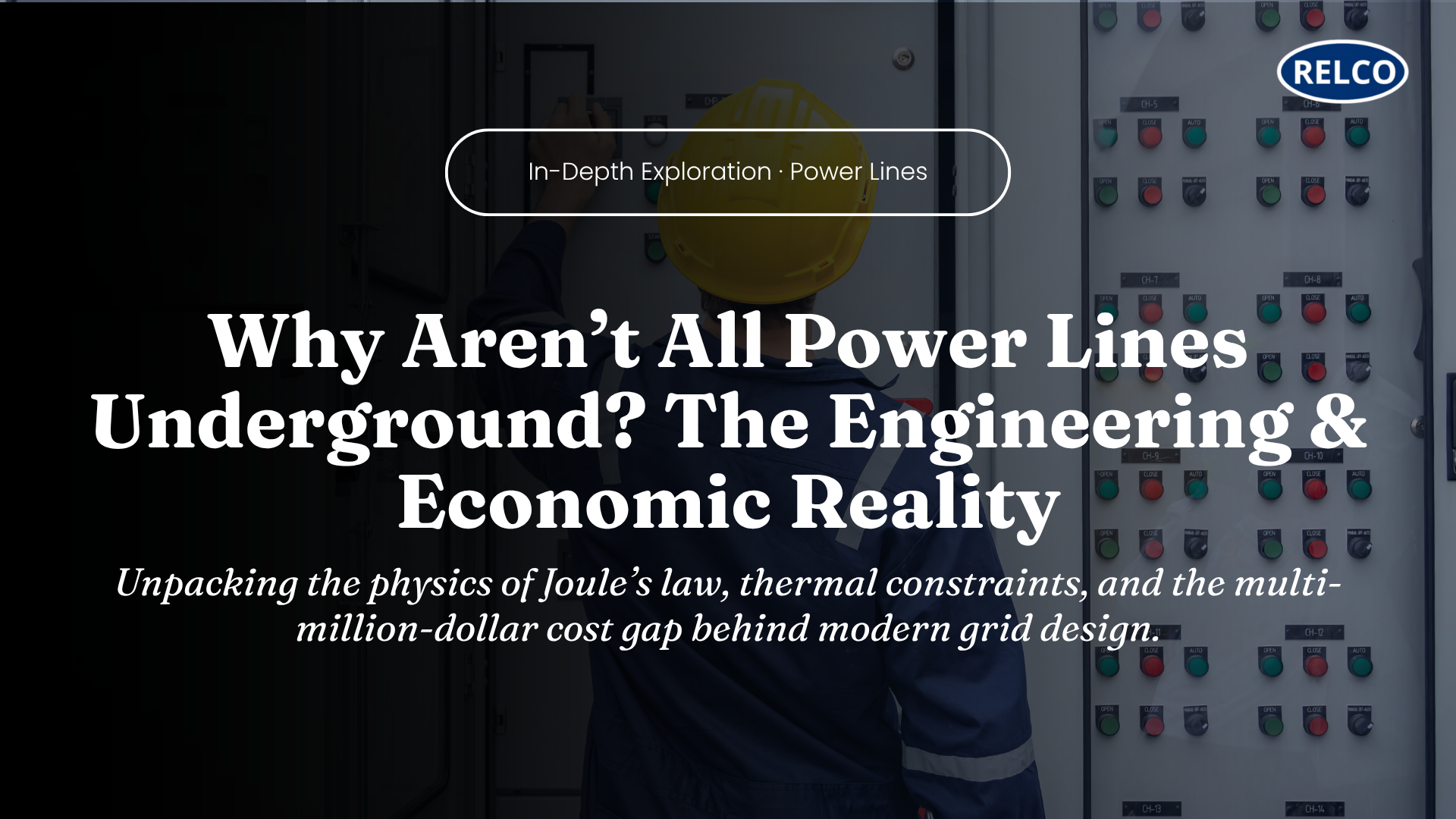
Whenever a severe storm rolls through a region, knocking down trees and snapping wooden utility poles, the public outcry is almost always identical: "Why don't we just bury all our power lines underground?" On the surface, it seems like a flawless argument. Underground power lines eliminate visual clutter from our horizons, stay completely protected from raging winds, ice storms, and lightning strikes, and significantly minimize vehicular accidents involving roadside utility structures.
Yet, despite these highly visible advantages, towering steel lattice structures carrying thousands of miles of bare metal wire still stretch aggressively across global landscapes, highways, and residential borders. This infrastructure setup is not born out of laziness or regulatory neglect. Instead, it is the result of a meticulously calculated engineering balance that involves strict laws of thermodynamic physics, deep economic realities, long-term grid restoration math, and advanced materials science.
1. The Fundamental Physics of High-Voltage Power Transmission
To grasp why power grids operate this way, we must look at how electricity is moved over massive geographical expanses. Power generation plants (hydroelectric dams, nuclear facilities, massive solar farms) are usually built hundreds of miles away from major consumer population zones. As electricity travels through a wire, it naturally fights against the internal resistance of the metal conductor material. According to Joule's First Law of Physics, this resistance converts valuable electrical energy into wasted heat:
In this physical equation, P_loss represents the electrical power converted directly into waste thermal heat, I represents the electrical current flowing through the line in Amperes, and R stands for the baseline resistance of the conductor wire. Because the power loss scales exponentially with the square of the current ($I^2$), doubling the current increases your energy losses by four times.
To bypass this hurdle, power companies use massive transformers to step up the transmission voltage to extraordinary levels—ranging between 110,000 volts (110 kV) and 765,000 volts (765 kV). By elevating the voltage, they can reduce the current proportional to the power delivered, allowing vast pools of energy to cross entire continents with minimal heat generation. However, managing these extreme voltages requires a flawless insulation system to prevent the current from jumping out of the wire and grounding itself out catastrophically.
2. The Economic Realities: Analyzing Capital Expenditure (CapEx)
The single most dominant constraint in grid design is project cost. Overhead high-voltage lines use bare, uninsulated aluminum conductors reinforced with steel cores (ACSR). Because these lines are hung dozens of feet in the air, the ambient atmosphere acts as a free, endless, and highly effective natural insulating medium. The major expenses are limited to purchasing raw steel towers, pouring basic concrete foundations at broad intervals, and stringing the bare metal cables.
Undergrounding completely flips this economic model. Since the earth, moisture, and rock surrounding a buried cable can easily conduct electricity, the cables cannot be bare metal. Instead, they must be wrapped in massive, technologically complex layers of specialized insulation, such as Cross-Linked Polyethylene (XLPE), followed by metallic shielding, moisture barriers, and heavy outer polymer jackets. Additionally, instead of setting towers every 1,000 feet, crews must continuously excavate miles of continuous trenches, maneuver around pre-existing municipal utilities, build reinforced underground concrete splice vaults, and deploy specialized heavy machinery.
| Infrastructure Asset Metric | Overhead Transmission Grid | Underground Transmission Cables |
|---|---|---|
| Capital Construction Cost | Baseline Standard Reference (1x) | 4x to 14x premium inflation depending on terrain |
| Primary Insulation Method | Free Ambient Atmospheric Open Air | Thick Solid Synthetic Polymers (XLPE) or Pressurized Dielectric Gas/Oil |
| Long-term Operational Lifespan | Extremely high lifespan (50 to 80 Years) | Limited durability window (30 to 40 Years) |
| Right-of-Way (RoW) Ground Use | Wide buffer, but surface allows farming/roads | Narrow path, but strictly blocks tree roots and heavy buildings |
| Initial Environmental Disruption | Low localized footprint around individual towers | High localized impact via uninterrupted open-cut trenching |
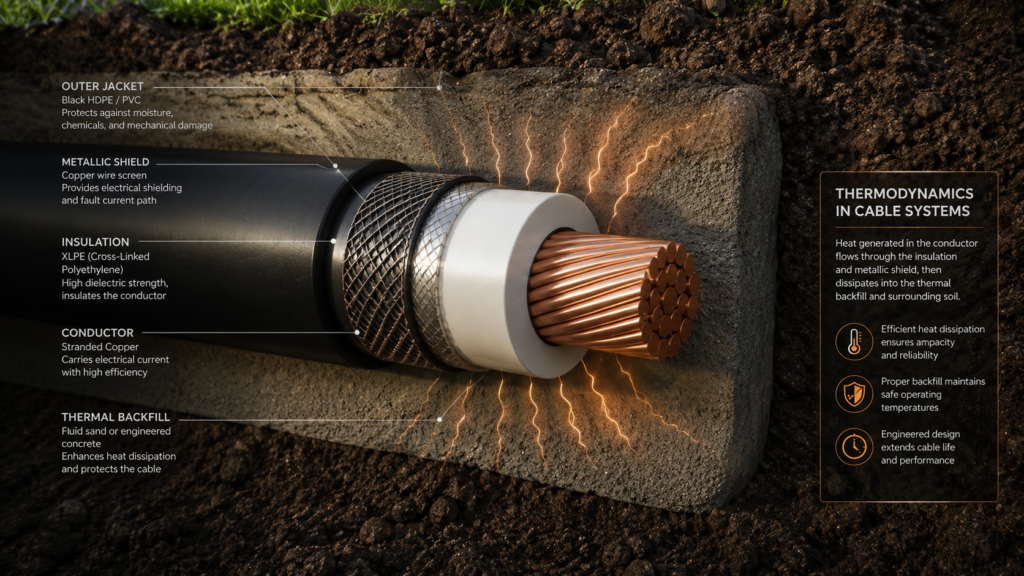
3. The Thermal Nightmare: Overcoming Heat Trapping in Buried Soil
As electricity flows, heat generation is an inevitable physical consequence. In an overhead line setup, this heat is rapidly dispersed into the environment via natural wind currents and atmospheric convection. Even during sweltering summer afternoons, the air movement keeps the metal conductors operating within safe structural temperature thresholds.
When you bury that same high-voltage line, it becomes surrounded by soil, clay, sand, or concrete, all of which are highly efficient thermal insulators. The heat generated by the electricity gets trapped immediately. If the core temperature rises too high, the synthetic insulation wrapping the cable will quickly degrade, become brittle, crack, and cause an explosive short-circuit failure deep underground.
To safely combat this thermal buildup, engineers are forced to make deep compromises. They must use substantially thicker copper or aluminum conductors to naturally lower resistance and decrease base heat output. Additionally, standard excavated dirt cannot be used to refill the trenches. Crews must import specially engineered thermal backfill—highly precise mixtures of fluid sand and specialized concrete designed to draw heat away from the conductors. In incredibly dense city centers, utilities even install forced cooling systems that continuously pump chilled oil, water, or pressurized nitrogen gas parallel to the power lines to actively prevent the system from cooking itself from the inside out.
4. Maintenance Dynamics and the "Out of Sight, Out of Mind" Paradox
It is a common belief that underground systems are definitively more reliable because they are completely sheltered from severe weather anomalies. While it is true that buried lines experience significantly fewer weather-triggered failures annually compared to overhead grids, this metric only tells half the story. The true test of a system's reliability lies in a combination of failure frequency and total restoration time.
When an overhead line encounters an issue—such as a lightning strike fracturing an insulator assembly or a tree limb falling across the conductors—the utility company can pinpoint the problem instantly. Repair crews can drive down the right-of-way, perform a quick visual inspection, deploy a bucket truck, and fix the mechanical damage within hours. The asset is highly accessible, and repairs are straightforward.
When a failure strikes an underground cable, finding the issue is an immediate technical challenge. The fault is completely hidden beneath feet of asphalt, earth, or concrete. To find the exact location of insulation failure, engineers must bring in advanced mobile testing units that deploy specialized radar-like diagnostics, such as Time Domain Reflectometry (TDR). These systems launch high-frequency electrical pulses down the line to measure exactly where the signal bounces off damaged insulation layers. Once the location is found, crews must obtain city emergency excavation permits, block traffic lanes, cut through pavement, and dig down carefully to reveal the damaged conduit. Splicing high-voltage lines requires ultra-sterile conditions; a single microscopic grain of sand or droplet of humidity trapped inside a splice joint can trigger a repeat failure when re-energized. Consequently, a repair that takes four hours on an overhead tower can take days or even weeks to resolve underground.
5. Advanced Electrical Engineering: The Physical Problem of Capacitance
Beyond capital costs and thermodynamic challenges, high-voltage Alternating Current (AC) power lines buried underground face a steep physical limitation known as parasitic capacitance. An underground cable consists of a central metallic core carrying high-voltage current, wrapped in an insulating layer, and surrounded by a grounded outer metallic shield to ensure safety. Structurally, this is the exact definition of a classic capacitor asset.
As Alternating Current oscillates back and forth (50 to 60 times every single second), the cable constantly charges and discharges its surrounding electrostatic field. This phenomenon creates a continuous "charging current" that consumes the actual current-carrying capacity of the cable long before it ever reaches the destination grid. Over long distances, typically past 20 to 30 miles (32 to 48 km), this capacitive charging current becomes so severe that it hogs the entire thermal rating of the line, leaving absolutely zero room to transmit usable power to consumers.
"Due to severe capacitive energy losses, running ultra-long distance high-voltage AC lines underground is an absolute physical impossibility without inserting highly complex reactive compensation stations at fixed geographic intervals, or converting the entire grid structure into costly High-Voltage Direct Current (HVDC) systems."
6. Strategic Deployments: Where Underground Transmission is Mandatory
Despite these engineering hurdles, burying high-voltage lines is not just an aesthetic luxury; in many modern contexts, it is the only viable option available to developers:
- Dense Megacities: In heavily populated metros like London, Tokyo, or New York, there is no physical land footprint available to build massive overhead tower corridors safely.
- Aviation Safety Zones: High-voltage towers near busy airport approach paths introduce unacceptable collision risks for landing aircraft.
- Major Water Crossing Corridors: Spanning vast rivers, bays, and marine environments often requires submarine cables buried deep in the seafloor bed.
- Protected Heritage Sites: In historic districts, national parks, and scenic reserves, preserving the historical and natural aesthetic outweighs the steep cost premium.
Conclusion: A Smart, Hybrid Power Grid Matrix
Ultimately, there is no singular superior technology between overhead and underground power transmission. The global grid is a hybrid ecosystem built entirely on selecting the right tool for the right scenario. Overhead lines remain the undisputed heavy-duty highways of global energy, moving bulk electricity across expansive continents affordably, efficiently, and with minimal maintenance friction. Underground systems serve as the precise, localized capillaries that thread this energy safely into crowded urban zones and delicate environments.